

Blog
Why Does Perfume Smell Different on Everyone? The Science Behind Your Scent

You try a perfume on a friend and immediately love it. It smells warm, smooth and slightly sweet, so you decide to try the same fragrance yourself. Yet on your skin, it smells sharper, fresher or less noticeable. The difference can feel surprising, especially when you use the exact same perfume.
Your skin, the surrounding temperature and your sense of smell can all influence the experience. Fragrance ingredients also evaporate at different rates, so a perfume can change throughout the day. Understanding these factors helps you make sense of a fragrance rather than dismissing it after the first spray.
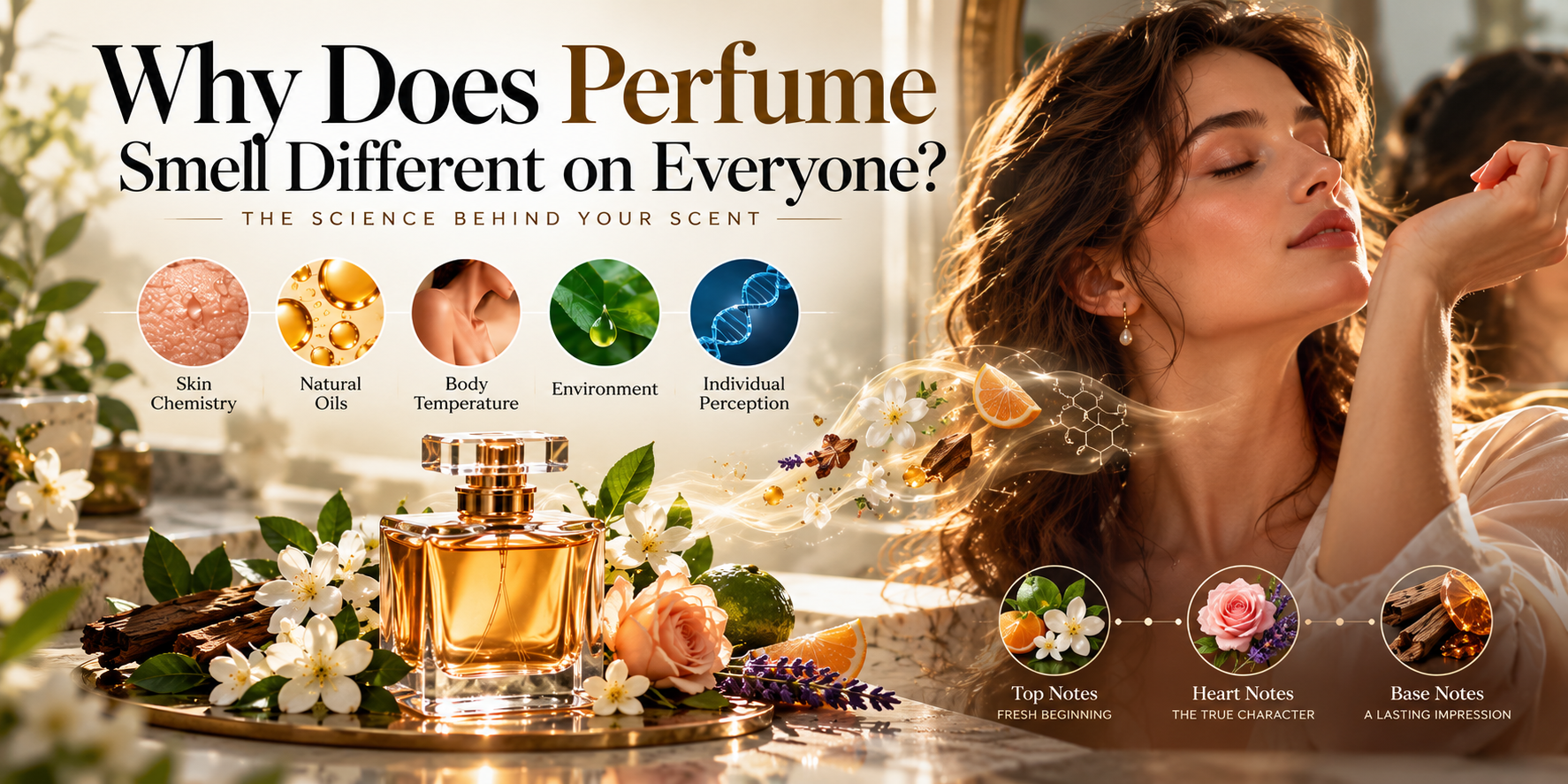
Why Does Perfume Smell Different on Everyone? The answer comes down to the interaction between fragrance ingredients, skin conditions and individual smell perception. The perfume formula gives the scent its main character, but your skin and nose influence the details you notice.
What Happens When Perfume Meets Your Skin?
Perfume contains aromatic compounds that release scent molecules into the air. Your nose detects those molecules and sends signals to your brain, which interprets the smell. The way a fragrance develops depends on its ingredients, the conditions on your skin and how your nose responds to each aroma.
Your skin produces sebum, a natural oil that helps protect its surface. Skin moisture and temperature also vary between people. These differences can influence fragrance wear, although they do not automatically turn the same perfume into a completely different scent.
For example, someone may notice a perfume’s fresh opening for longer, while another person may focus on its warmer notes later in the day. That difference does not necessarily mean the perfume has changed chemically; the two people may experience different parts of its development.
Skin Oils, Moisture and Natural Body Scent
People often say that perfume lasts longer on oily skin than on dry skin. Skin oils and moisture can influence fragrance behaviour, but this rule does not apply to every formula. The ingredients, concentration and application conditions also affect how long you notice a scent.
Your natural body odour adds another layer. Skin secretions and microorganisms contribute to individual body scent, which may mingle with the fragrance you apply. The result can influence the overall impression, but no single type of skin chemistry guarantees a better-smelling perfume.
Skin pH also receives attention in fragrance discussions. It measures how acidic or alkaline your skin’s surface is, but a small pH difference does not automatically change a perfume’s character. Avoid blaming skin pH alone when a fragrance smells different.
Why Your Nose May Experience a Different Fragrance
Skin does not explain every difference. People also vary in their sensitivity to aroma compounds, which means two people can notice different aspects of the same perfume.
One person might immediately recognise bergamot or lemon, while another notices the fragrance’s woody, musky or sweet character. Genetics can influence sensitivity to certain smells, and memories can shape how you interpret them. A floral note might remind you of fresh flowers but remind someone else of scented soap.
Your nose can also become less responsive to a fragrance you wear frequently. Scientists call this process olfactory adaptation. If you stop noticing your perfume after a short time, other people may still smell it.
This explains why adding more sprays does not always solve the problem. Give your nose a break before deciding that your fragrance has lost its strength.
How a Perfume Changes from the First Spray to the Dry-Down
A perfume rarely smells exactly the same from beginning to end. Different ingredients evaporate at different rates, which creates the familiar progression from top notes to heart notes and finally to base notes.
| Fragrance stage | Common examples | What you may notice |
| Top notes | Bergamot, lemon, grapefruit | A bright, fresh opening |
| Heart notes | Rose, jasmine, lavender | The fragrance’s developing character |
| Base notes | Woods, musk, vanilla, resins | A warmer scent that may linger |
These stages help you understand fragrance development, but they do not follow a fixed timetable. A citrus perfume may open brightly before revealing a woody base, while a rich amber fragrance may feel warm from the start.
Concentration also influences the fragrance experience. Eau de Toilette (EDT), Eau de Parfum (EDP) and parfum use different fragrance formulations, although exact concentrations vary by manufacturer. A higher concentration does not automatically guarantee stronger projection or longer wear.
Bottle size tells you how much liquid you receive, not how the fragrance smells. A 10 ml travel spray, 30 ml bottle, 50 ml bottle and 100 ml bottle can contain the same formula at the same concentration. If two bottles smell noticeably different, check whether they contain the same version of the fragrance and whether either bottle has deteriorated.
Why a Perfume Can Smell Different After Several Months
Sometimes the difference comes from the perfume itself rather than your skin. Heat, sunlight and repeated exposure to air can gradually affect fragrance ingredients. Oxidation and other chemical changes may alter the original scent.
Store your perfume in a cool, dry place away from direct sunlight and frequent temperature changes. A bedroom drawer or cupboard often provides better conditions than a sunny windowsill or a warm bathroom.
If a familiar fragrance develops an unusual smell, compare it with your previous experience and check its storage history. A temporary difference in how you perceive a scent does not necessarily mean the perfume has expired.
How to Find a Perfume That Smells Right on You
A paper blotter gives you a useful first impression, but testing a fragrance on your own skin helps you understand how it develops in your everyday conditions. Give the perfume time before deciding whether it suits you.
- Start with a scent family you enjoy. Explore citrus, floral, woody, aromatic or musky fragrances without assuming every perfume in one family smells alike.
- Apply a small amount. Test one spray on clean skin and avoid rubbing the area.
- Check the fragrance later. Revisit the scent after 30 minutes and again later in the day; these are practical checkpoints, not universal timelines.
- Compare fragrances separately. Testing too many scents together can make individual notes harder to recognise.
- Keep your observations simple. Note the opening, the later scent and how noticeable the fragrance remains.
- Consider your surroundings. Weather, activity and scented skincare products can affect the result, so keep these factors similar when comparing perfumes.
If a fragrance smells excellent on someone else but not on you, that does not mean you have chosen a bad perfume. You may prefer a different balance of notes, or the fragrance may simply develop in a way that does not match your taste.
The most useful test is whether you enjoy the complete scent on your own skin, from the first spray to the later dry-down.
Understanding Your Unique Fragrance Experience
A perfume’s formula creates its main character, but skin conditions, evaporation and individual smell perception influence the way you experience it. Give fragrances time to develop, compare them under similar conditions and avoid judging them solely by their opening notes.
DePerfume encourages a thoughtful approach to fragrance: explore different scent families, pay attention to the notes you enjoy and choose a perfume that fits your own preferences rather than someone else’s experience.
Frequently Asked Questions
What is the 30/50/20 rule for perfume?
The 30/50/20 rule has no single, widely accepted meaning in perfumery, so check what a particular guide means before following its percentages. For everyday application, start with a small number of sprays and adjust to the fragrance’s strength and setting.
Why doesn’t my perfume smell the same anymore?
Your nose may have adapted to a familiar scent, or changes in weather and skincare may affect your experience. If the difference continues, check for heat exposure, sunlight or signs that the fragrance has deteriorated.
What is the most attractive smell to humans?
No single scent attracts everyone because personal preferences, memories and smell sensitivity differ. Try fresh, floral, woody and musky fragrances to discover which scent styles you enjoy most.
Can others smell my perfume even if I can’t?
Yes, olfactory adaptation can make your perfume less noticeable to you while other people can still detect it. Ask someone you trust for feedback before applying more, because extra sprays may make the fragrance too strong.