


Blog
Perfume Travel Sizes Explained: How to Choose the Right Bottle

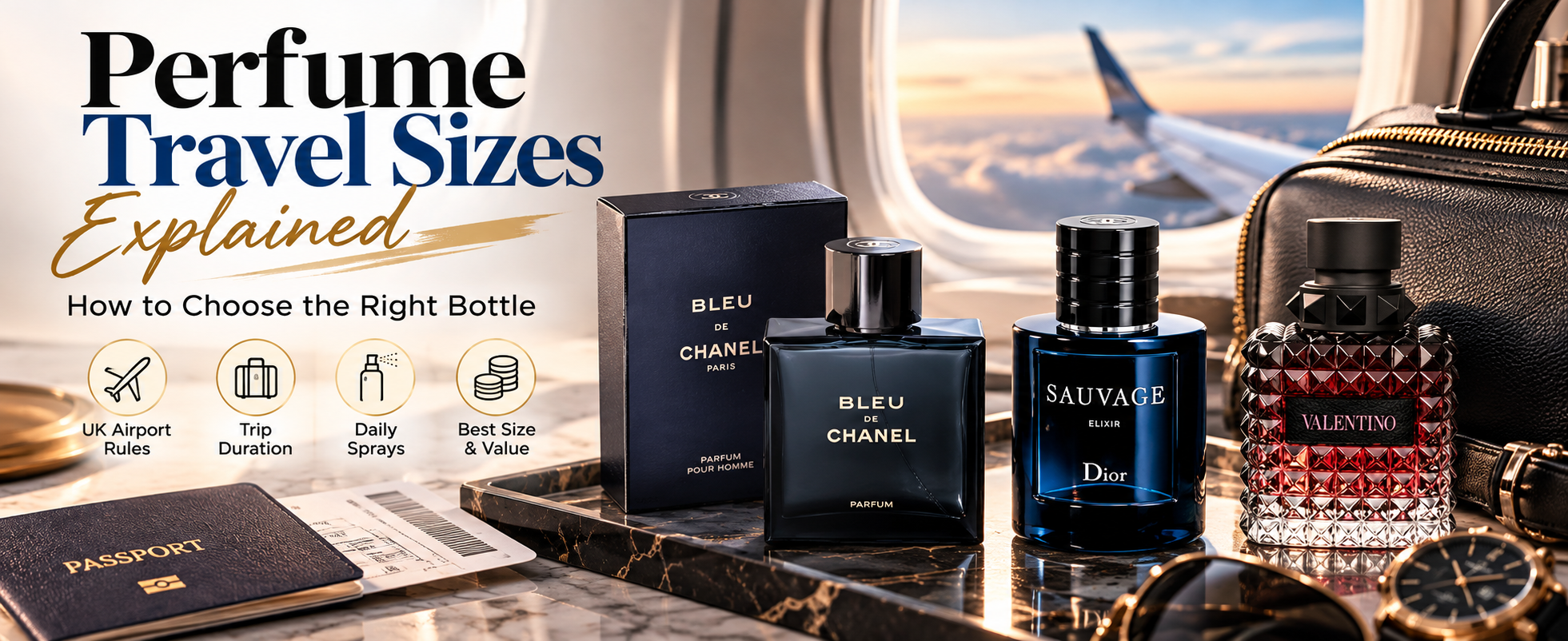
Choosing a perfume for a trip is easy. Deciding how much to take can be less straightforward. A bottle that works for a weekend away may not suit a two-week holiday, especially if you like to reapply your fragrance during the day.
Perfume travel sizes give you a way to carry fragrance without packing a full-size bottle. The right option depends on your trip length, how many sprays you use, and whether you want to test a new scent or take a favourite perfume with you. A 5 ml sample may suit occasional use, while a 10 ml or 15 ml spray offers more fragrance in a compact format.
This guide explains the differences between bottle sizes, how to estimate your needs, what to check before buying, and how UK airport liquid rules affect your choice.
What Are Perfume Travel Sizes?
Perfume travel sizes are smaller versions of fragrances or compact containers that hold a limited amount of perfume. They make it easier to carry a scent in a handbag, wash bag or cabin suitcase.
The term covers several products, and they do not all work in the same way:
- Mini perfume bottles: Small bottles that may contain the original fragrance in miniature packaging.
- Perfume sample vials: Small containers designed mainly for testing a scent.
- Travel sprays: Compact, usually pre-filled bottles with a spray mechanism.
- Perfume travel atomizers: Refillable containers that hold perfume transferred from a larger bottle.
- Decants: Smaller quantities of fragrance transferred from a larger bottle into another container.
These differences matter. A sample helps you test a fragrance, while a refillable atomiser lets you carry a scent you already own. Check the product description to understand exactly what you are buying.
Perfume Travel Sizes: Which Bottle Size Do You Need?
The best size depends on how much fragrance you use and how long you will be away. This comparison can help you narrow down your options.
| Bottle capacity | Best suited to | What to consider |
| 1–2 ml | Testing a fragrance | A small amount for trying a scent |
| 5 ml | Short trips or occasional use | Compact, but may need refilling on longer trips |
| 10 ml | Regular travel and daily carry | A useful balance between size and quantity |
| 15 ml | Longer trips or frequent applications | Holds 50% more perfume than a 10 ml bottle |
| 30 ml | Regular wear and fragrance rotation | Larger than many compact travel sprays |
| 50 ml | Frequent use of a favourite scent | More fragrance, but takes up more space |
| 100 ml or more | Regular use at home | Check airport rules if you plan to carry it in hand luggage |
These are common examples rather than fixed industry categories. Brands offer different capacities, so always check the stated volume.
1–2 ml: Perfume Samples for Testing
A small sample vial is useful when you want to try a fragrance before buying a larger bottle. It lets you experience the scent on your skin rather than judging it only from a description.
Wear the fragrance for several hours and notice how it changes. The opening notes may smell different from the scent that remains later in the day. A sample can help you decide whether you enjoy the full fragrance experience.
However, a sample may not contain enough perfume for a longer trip. Check whether it uses a spray or dabber, as the application method can affect how you use it.
5 ml: A Compact Option for Short Trips
A 5 ml perfume is useful when you want to travel light. It can suit a weekend away, an occasional evening out or someone who wears fragrance sparingly.
Its small capacity also makes it practical for testing a scent over several applications. However, if you apply perfume many times a day, you may need a larger bottle.
10 ml: A Practical Everyday Travel Size
A travel size perfume in a 10 ml bottle offers more fragrance than a small sample without taking up much space. It can suit a short holiday, a work bag or regular use away from home.
A 10 ml bottle may be a good starting point if you want to carry one familiar fragrance. The actual number of applications depends on the sprayer and how much perfume you use each time.
15 ml: More Fragrance in a Compact Bottle
A 15 ml bottle contains 50% more liquid than a 10 ml bottle. That extra capacity may help if you are travelling for longer or tend to reapply perfume during the day.
It will take up slightly more room, so consider its dimensions as well as its volume. Two bottles with the same capacity can have different shapes and may fit your bag differently.
30–50 ml: For Regular Use
Bottles of 30 ml and 50 ml suit people who wear the same fragrance frequently or want more than a small travel spray provides.
A 30 ml bottle may work well if you enjoy changing fragrances. A 50 ml bottle may suit a scent you wear regularly. Compare the price per millilitre, but remember that a larger bottle is not automatically better value if you rarely use it.
How Much Perfume Do You Need for Your Trip?
Instead of guessing, estimate how often you plan to apply perfume. Your usual routine gives you a better starting point than the number of days alone.
For example, someone who applies two sprays once a day will use less perfume than someone who applies four sprays in the morning and reapplies later. The sprayer also matters because different designs release different amounts of liquid.
A useful way to estimate your needs is to follow these steps:
- Count your usual sprays. Note how many sprays you use during a normal application.
- Estimate daily applications. Decide whether you will apply perfume once or several times a day.
- Consider your trip length. Multiply your expected daily use by the number of days away.
- Allow for changes. You may use more fragrance for evenings out or special occasions.
- Choose a suitable capacity. Compare your estimated needs with the bottle sizes available.
As an example, if you use two sprays each morning and plan a seven-day trip, you would need 14 sprays for your morning routine. If you also plan evening applications, include those in your estimate.
You do not need to calculate the exact number of sprays in every bottle. The aim is to avoid carrying a large bottle unnecessarily or running out of fragrance halfway through your trip.
Travel Size Perfume vs Full-Size Bottles
Both small and large bottles have advantages. The right choice depends on your travel plans and how often you use the fragrance.
| Factor | Travel-size bottle | Full-size bottle |
| Portability | Usually easier to carry | Often takes up more space |
| Quantity | Holds less perfume | Holds more perfume |
| Initial cost | May cost less overall | Usually requires a larger upfront spend |
| Price per ml | Can be higher | May be lower, depending on the price |
| Fragrance variety | Makes carrying several scents easier | Suits regular use of one fragrance |
A smaller bottle may suit someone who owns several perfumes or wants to test a new scent. A full-size bottle may make more sense for a fragrance used regularly at home.
Compare the actual price and volume rather than assuming that one format always offers better value.
Mini Perfume Bottles, Travel Sprays and Refillable Atomisers
These formats can look similar, but their purpose and construction may differ.
Mini Perfume Bottles
Mini perfume bottles may reproduce the design of a full-size fragrance in a smaller format. Some contain the original fragrance and use a spray mechanism, while others come with a simple stopper or dabber.
Check the product description for the bottle’s capacity, application method and whether it is a complete miniature or a sample.
Pre-Filled Travel Sprays
A pre-filled travel spray arrives ready to use. You do not need to transfer perfume from another bottle, which makes it a convenient choice if you want a straightforward option for travel.
Check the stated fragrance, volume and packaging before buying. A compact bottle is only useful if it contains the scent you want and fits your intended use.
Refillable Perfume Travel Atomizers
A perfume travel atomizer lets you transfer a small amount of fragrance from a larger bottle into a compact container. This can be useful if you already own a perfume and do not want to carry the original bottle.
Before filling an atomiser, check that it is designed for fragrance and that its filling method suits your bottle. Follow the manufacturer’s instructions, avoid overfilling it and secure the closure properly.
If you plan to switch between fragrances, clean the container according to the manufacturer’s guidance. Residual perfume can affect the smell of the next fragrance you add.
What Should You Check Before Buying Travel Perfume Bottles?
The bottle size is only one part of the decision. Packaging, product details and price can affect how useful a travel fragrance will be.
- Capacity: Check the exact volume in millilitres.
- Spray mechanism: Confirm whether the bottle sprays or uses a dabber.
- Leak resistance: Look for a secure cap and well-fitted closure.
- Bottle material: Choose packaging designed to hold fragrance.
- Refill compatibility: Make sure a refillable atomiser works with your intended perfume.
- Price per millilitre: Compare the cost of different sizes.
- Product authenticity: Check whether the listing describes an original miniature, an authorised travel spray or a separately filled decant.
These details help you compare products fairly. A lower price does not tell you everything about a bottle’s quality, and a small format does not automatically make a product suitable for every trip.
Can You Take Perfume in Hand Luggage in the UK?
Yes, you can generally take perfume in hand luggage, but the rules depend on the airport. Perfume counts as a liquid under airport security rules.
At many UK airports, liquids must be in containers of no more than 100 ml. Some airports now allow larger containers under different screening arrangements, so you should check the latest rules before travelling. The official GOV.UK guidance confirms that liquid restrictions vary by airport. Before you pack your fragrance:
- Check the rules at your departure airport.
- Check the requirements at any connecting airports.
- Confirm the rules for your return journey.
- Follow any instructions about transparent resealable liquids bags.
- Protect the bottle against leaks and breakage.
A container’s capacity matters under a 100 ml limit, even if the bottle is only partly full. Do not assume every UK airport follows the same rules. If you place perfume in checked baggage, secure the cap and protect the bottle from knocks. A sealed bag can help contain a leak if one occurs.
How Long Does a Travel-Size Perfume Last?
The lifespan of a travel perfume depends on the bottle’s capacity, the amount released by each spray and how often you apply it.
For example, a 15 ml bottle holds 50% more liquid than a 10 ml bottle. It does not necessarily last 50% longer for every person, because usage habits and sprayer output can differ.
To get a better estimate, track how many sprays you use each day. If you apply fragrance twice daily, your bottle will run out sooner than it would with one application a day.
Store perfume away from direct sunlight and excessive heat. Keep the cap secure between uses and follow the storage advice on the packaging. These steps help protect the fragrance from avoidable exposure.
Final Thoughts
The best perfume travel size is the one that matches your routine. Small samples help you test fragrances, 5 ml bottles suit light use, and 10–15 ml sprays offer a useful balance between portability and quantity. Larger bottles may suit people who wear the same fragrance regularly.
Before buying, consider how many sprays you use, how long you will be away, the bottle’s design and the price per millilitre. Check airport restrictions before flying, and store your fragrance away from excessive heat and direct sunlight.
DePerfume encourages informed fragrance choices by helping shoppers understand bottle sizes, packaging and practical travel considerations before they decide which option suits them.
Frequently Asked Questions
What Is the Best Size Perfume Bottle for Travel?
A 10 ml or 15 ml bottle is a practical option for many travellers because it offers more fragrance than a sample while remaining compact. For a short trip with occasional use, a 5 ml bottle may be enough. Choose according to your routine and check airport liquid rules before flying.
What Is the 3-1-1 Rule for Perfume?
The 3-1-1 rule is a United States TSA rule for carry-on liquids. It generally refers to containers of up to 3.4 US fluid ounces (100 ml), packed in one quart-sized clear bag per passenger. It is not a universal UK airport rule, so check the requirements for your specific journey.
Which Is Bigger: 1.7 oz or 3.4 oz?
A 3.4 oz perfume bottle is larger. These common perfume labels correspond approximately to 50 ml for 1.7 US fluid ounces and 100 ml for 3.4 US fluid ounces.
What Is the 30/50/20 Rule for Perfume?
There is no universally established perfume-industry standard known as the 30/50/20 rule. Its meaning depends on the source using the term, so check the original explanation before treating it as a recognised fragrance guideline.
How Long Does a 10 ml Travel Perfume Last?
A 10 ml bottle may last several days or several weeks, depending on how much perfume each spray releases and how often you use it. Track your normal routine to estimate how much you need for a trip.
Are Travel-Size Perfumes Worth Buying?
Travel-size perfumes can be useful if you travel frequently, enjoy testing fragrances or want to carry a smaller amount of a favourite scent. Compare the price per millilitre, packaging and capacity to decide whether the smaller format suits your needs.