

Blog
What Is Perfume Dry Down? A Complete Guide

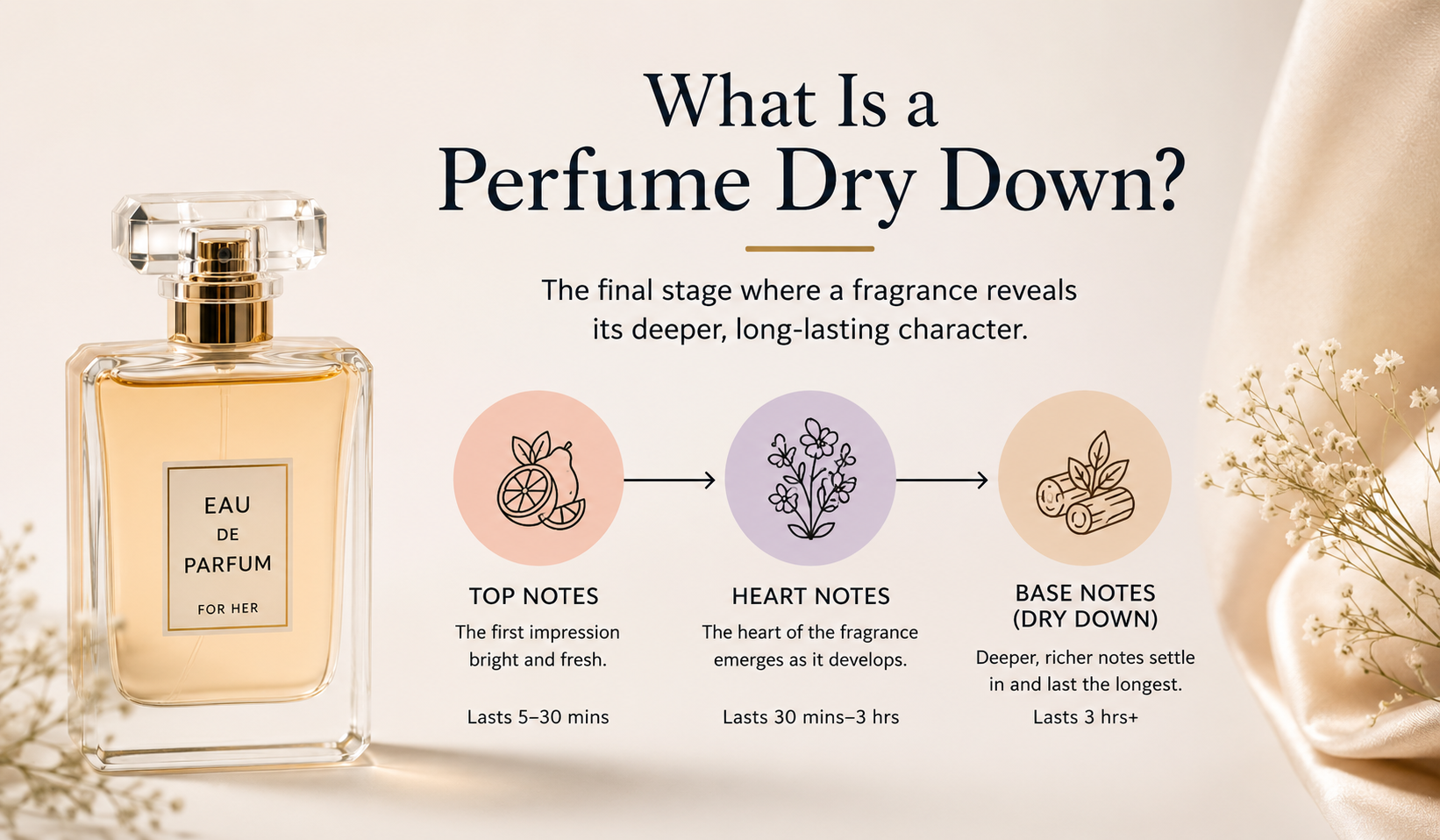
A perfume can smell completely different five minutes after spraying it compared with the fragrance you notice several hours later. That change is not a sign that the perfume has gone wrong. It is part of how fragrance is designed to evolve on your skin.
This later stage is known as the perfume dry down.
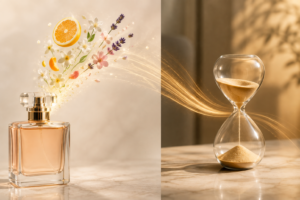
The dry down is the stage when the faster-evaporating parts of a fragrance have become less prominent and the slower-moving materials and deeper accords become more noticeable. It is often where you discover the real character of a perfume: perhaps a creamy vanilla becomes warmer, a floral fragrance becomes musky, or a fresh opening settles into woods, amber or patchouli.
Understanding dry down can completely change the way you shop for perfume. Instead of judging a fragrance from the first spray alone, you can learn how to experience its full development and decide whether it genuinely suits you.
What Is Dry Down in Perfume?
Perfume dry down is the later stage of a fragrance’s development on skin, when the initial volatile ingredients have faded and the composition settles into its longer-lasting character.
It is closely associated with a perfume’s base notes, but dry down and base notes are not exactly the same thing.
A fragrance is made from many aromatic materials with different rates of evaporation. As the composition interacts with the skin and the surrounding air, some ingredients become less noticeable while others remain prominent. The result is a scent that gradually changes rather than staying identical from the moment you spray it.
This is why a perfume can open with bright bergamot and citrus, develop into flowers or spices, and eventually feel warmer, smoother or woodier.
The final impression depends on the complete formula, not simply one “base note.”
How Does a Perfume Develop on Your Skin?
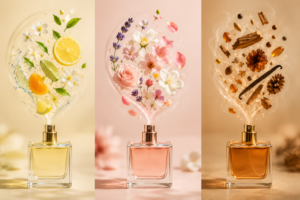
Fragrance development is commonly explained through three stages: top notes, heart notes and base notes.
These terms are useful, but it is better to think of them as overlapping parts of a composition rather than three completely separate periods with a precise start and finish.
1. Top Notes: The First Impression
Top notes are usually the first aromas you notice after spraying.
They are often associated with ingredients and accords such as:
- Bergamot
- Lemon
- Grapefruit
- Orange
- Lavender
- Light fruits
- Green accords
- Fresh aromatic notes
Top notes can create the immediate personality of a fragrance. They may make a perfume feel sparkling, crisp, juicy, airy or energetic.
However, they are generally made from more volatile materials, so their prominence tends to decrease relatively quickly.
That does not mean the top notes simply disappear at one exact moment. Their presence can overlap with the heart of the fragrance as the perfume continues to develop.
2. Heart Notes: The Main Character
As the opening settles, the heart of the fragrance becomes easier to recognise.
Heart notes and accords commonly include:
- Rose
- Jasmine
- Tuberose
- Iris
- Orange blossom
- Cinnamon
- Cardamom
- Fruity accords
- Aromatic herbs
The heart gives the perfume much of its personality and helps connect the bright opening with the deeper materials underneath.
A fragrance that initially seems very citrusy might become noticeably floral after some time. A fresh aromatic perfume might reveal spices or woods. A sweet opening might become creamier as the composition progresses.
3. Base Notes: The Foundation
Base notes are generally associated with the longest-lasting part of a fragrance.
Common examples include:
- Vanilla
- Musk
- Sandalwood
- Cedarwood
- Vetiver
- Patchouli
- Amber accords
- Tonka bean
- Oud
- Resins
- Leather accords
These materials can give a perfume warmth, depth, smoothness and persistence.
The base is particularly important during the dry down, but describing dry down as simply “the base notes” misses an important detail: you are experiencing the fragrance’s evolving composition, not switching from one ingredient group to another.
What Does a Perfume Dry Down Smell Like?
There is no universal dry-down smell.
That is one of the most interesting things about fragrance.
A perfume with vanilla, amber and sandalwood may become creamy and warm. A woody fragrance may become drier and earthier. A floral perfume can settle into musk and woods, while an oud fragrance may become darker and smoother.
For example, a fragrance might begin with bright bergamot, move into lavender and florals, and later reveal woods, musk or amber.
The dry down is therefore not automatically sweet, heavy or woody. Its character depends on the fragrance formula.
This is also why understanding individual fragrance ingredients can help you choose scents more confidently.
How Long Does It Take for Perfume to Dry Down?
There is no single dry-down time that applies to every perfume.
You may notice significant changes within the first 20–30 minutes, while a fragrance can continue evolving for several hours. The exact pace depends on the formulation, concentration, ingredients, skin and environment.
Rather than waiting for an arbitrary number of minutes, think about the fragrance in stages:
First few minutes:
You experience the initial spray and the brightest part of the composition.
Around 20–60 minutes:
The opening generally becomes softer and the heart becomes easier to appreciate.
After an hour or more:
The deeper character of the fragrance becomes increasingly apparent.
Later wear:
The perfume may become softer and closer to the skin while remaining detectable.
Some fragrances change dramatically. Others are deliberately linear and maintain a relatively consistent character throughout wear.
So if someone asks, “How long does perfume take to dry down?” The most accurate answer is: it varies by fragrance, and drying down is a gradual process rather than a fixed point in time.
Why Does Perfume Smell Different After a Few Hours?
Perfume smells different over time because fragrance materials do not all evaporate at the same rate.
As the more volatile components become less prominent, slower-evaporating materials can have a greater influence on what you smell.
Your surroundings also matter.
Temperature, humidity, skin moisture and even how much fragrance you applied can influence your perception of the scent.
This is why judging a perfume immediately after spraying can sometimes give you an incomplete picture.
A fragrance that seems too sharp in the opening might become beautifully smooth later. Conversely, a perfume that smells fantastic at first may develop into a dry down that you do not enjoy.
Why Does the Same Perfume Smell Differently on Different People?
This is one of the most common reasons people are surprised by perfume.
A fragrance is not experienced in isolation. When applied to skin, its performance and perception can be influenced by factors such as:
Skin Moisture
Dry skin may provide a different environment for fragrance than well-moisturised skin.
Applying perfume to moisturised skin can sometimes help the scent remain noticeable for longer, although the effect varies between people and formulations.
Body Temperature
Warmth can influence how fragrance materials are released from the skin.
This is one reason a perfume may seem more expressive on warm skin than on a cooler surface.
Individual Skin Chemistry
Natural skin characteristics can influence how a fragrance is perceived.
That does not mean your skin completely “changes” the perfume. Rather, the same formula can interact with individual skin conditions and surrounding scent in ways that make the final impression slightly different.
Environment
Heat, cold, humidity and airflow can all affect how quickly you notice different aspects of a fragrance.
A perfume that feels rich and powerful indoors during winter may seem brighter and more diffusive outdoors in warm weather.
Does Perfume Concentration Affect Dry Down?
Concentration can influence how a fragrance develops and how long it remains noticeable, but it is not accurate to assume that every Eau de Parfum will automatically dry down more slowly or last longer than every Eau de Toilette.
Perfume performance depends on the entire formulation.
In broad terms:
- Eau de Toilette (EDT) often provides a lighter fragrance experience.
- Eau de Parfum (EDP) generally contains a higher proportion of fragrance concentrate than EDT.
- Parfum or Extrait can contain an even higher concentration of fragrance materials.
However, concentration alone does not determine longevity.
The ingredients, formula, application, skin and environment all matter.
For shoppers primarily interested in performance, our guide to long-lasting perfumes for women explains the factors that can influence fragrance longevity.
Dry Down vs Longevity: Are They the Same?
No.
Dry down describes how a fragrance develops toward its later stages.
Longevity describes how long the fragrance remains perceptible.
A perfume can have an interesting dry down without being exceptionally long-lasting.
Likewise, a very long-lasting perfume may eventually become extremely soft and close to the skin.
Two other terms are worth knowing:
Projection
Projection describes how far a fragrance radiates from your skin.
A perfume with strong projection may be noticeable to people standing nearby.
Sillage
Sillage refers to the scented trail a fragrance leaves behind as you move.
A fragrance can have moderate longevity but strong early projection, or long longevity with a much softer sillage.
Understanding these differences makes perfume reviews much easier to interpret.
Which Fragrance Notes Tend to Stand Out During Dry Down?
There is no universal list of “longest-lasting notes,” because fragrance formulas are complex. Still, certain materials and accords are frequently used to create depth and persistence.
Vanilla and Tonka Bean
These can give fragrances a creamy, sweet and warm character.
They are especially common in gourmand, amber and oriental-inspired compositions.
Woods
Sandalwood, cedarwood and other woody materials can create a dry, creamy, smooth or earthy foundation.
Musk
Musk accords can provide softness and a clean, skin-like quality while helping connect different parts of a fragrance.
Amber
Amber accords are often used to create warmth, sweetness and depth.
Oud
Oud can contribute woody, smoky, leathery or resinous qualities depending on the material and formulation.
For a deeper look at fragrance materials, see our perfume ingredients guide which covers ingredients such as musk, oud, vanilla and other important fragrance materials.
Why You Should Test the Dry Down Before Buying a Perfume
The first spray is only the beginning.
If you purchase a perfume based solely on its opening, you may end up with a fragrance that smells very different from what you expected after an hour.
A better approach is to give the fragrance time.
Step 1: Smell the Opening
Notice your first reaction.
Is it fresh, sweet, spicy, floral, fruity, woody, clean or smoky?
Do not make your final decision yet.
Step 2: Give It Time
Let the perfume develop naturally instead of repeatedly spraying it.
After around 20–30 minutes, smell it again and compare the developing character with your first impression.
The Perfume Shop similarly recommends waiting and smelling a fragrance more than once so you can experience its heart and dry down rather than judging it immediately.
Step 3: Test It on Skin
A blotter can be useful for comparing several fragrances, but skin testing gives you a more relevant picture of how the fragrance behaves when worn.
Apply a small amount to clean skin and allow it to develop.
Step 4: Check the Later Dry Down
Ask yourself:
- Do I still enjoy the fragrance?
- Has the sweetness become too strong?
- Has the freshness disappeared?
- Do I like the woody or musky finish?
- Is the fragrance comfortable for several hours?
- Would I actually want to wear it regularly?
That final question is often more useful than simply asking whether the first spray smells good.
Should You Buy a Perfume Based on Its Opening?
Usually, no.
The opening matters because it creates the first impression, but a perfume is designed to be experienced over time.
Imagine choosing a song after hearing only its first ten seconds. You might love the opening, but you would have no idea how the rest develops.
Perfume works in a similar way.
This is particularly important with richer fragrances containing vanilla, amber, woods, musk, oud, patchouli or gourmand accords. Their later character can be substantially different from their initial spray.
A Great Example: Why Fragrance Notes Matter
Take a fragrance such as YSL Black Opium.
Its coffee, vanilla and floral character demonstrates why the relationship between different fragrance materials matters. The perfume’s overall impression cannot be understood simply by looking at one ingredient.
Similarly, when you explore fragrances such as YSL Libre, the relationship between its fresh, floral and deeper elements helps explain why the scent feels different throughout wear.
How to Choose a Perfume by Its Dry Down
If you already know the types of scents you enjoy, dry down can become a powerful shopping tool.
If You Like Warm and Sweet Scents
Look for fragrances featuring vanilla, tonka bean, amber, caramel or gourmand accords.
These can create a comforting and rich later-stage character.
If You Prefer Clean Scents
Musk, soft woods, fresh florals and airy accords may be more appealing.
These styles can create a clean, understated finish.
If You Like Deep and Woody Fragrances
Explore sandalwood, cedarwood, vetiver, patchouli, oud and darker amber accords.
These ingredients can create a more grounded fragrance profile.
If You Prefer Fresh Perfumes
Citrus, aquatic, green and aromatic profiles may appeal to you, particularly if you prefer a lighter fragrance style.
Remember, however, that a fresh opening does not guarantee a fresh dry down. A citrus fragrance can eventually become musky, woody or creamy depending on its formula.
Common Dry Down Mistakes to Avoid
Judging a perfume after one spray
The opening is not the entire fragrance.
Assuming every perfume follows the same timeline
Fragrance evolution is formulation-dependent.
Confusing dry down with longevity
They describe different aspects of fragrance performance.
Assuming base notes are the only thing you smell
The fragrance remains a blend, and different materials can overlap.
Comparing only the opening of two perfumes
One fragrance may have a spectacular opening while another reveals its personality later.
Over-spraying while testing
Too much fragrance can overwhelm your nose and make comparison difficult. Give your sense of smell time to reset between different perfumes.
How Dry Down Helps You Find a Signature Scent
A signature scent needs to work beyond the first impression.
You want something that fits your personality, wardrobe, lifestyle and the situations in which you plan to wear it.
Perhaps you love a fragrance because its opening is bright and energetic, but after several hours its musky finish feels too heavy. Another perfume may seem ordinary at first but develop into exactly the warm, elegant scent you wanted.
That is why dry down deserves attention.
The best perfume is not necessarily the one that impresses you fastest. It may be the one you still enjoy after the excitement of the opening has faded.
Final Thoughts
A perfume’s dry down reveals how its fragrance truly develops beyond the first spray. Give it time on your skin, notice how the scent changes, and decide whether you still enjoy it after it settles.
At De Perfume Shop understanding fragrance evolution helps you choose perfumes with greater confidence—not just by the opening, but by the scent you’ll actually wear.
FAQs
What does dry down mean in perfume?
Dry down is the later stage of a fragrance when the initial notes fade and deeper elements become more noticeable. It reveals how the perfume smells after it has settled on your skin.
How long does perfume take to dry down?
There is no exact timeframe, as fragrances develop at different speeds. You may notice changes within minutes, while the final character can continue developing for several hours.
Is dry down the same as base notes?
Not exactly. Base notes are ingredients or accords associated with a fragrance’s deeper character, while dry down describes the later stage of the perfume’s overall development.
Why does my perfume smell different after a few hours?
Fragrance ingredients evaporate at different rates, changing the balance of the scent over time. Your skin, temperature and surrounding environment can also influence how the perfume develops.